

Why Fintech Lenders Are Holding On to Their Loans
July 2026

July 2026
A common view in venture capital is that the best businesses are asset light.
The logic is simple: equity is expensive, dilution matters, and businesses that require less capital can compound value more efficiently. It is one of the reasons software has dominated venture investing for the past three decades.
Lending seems to break that rule.
Every new customer requires capital, and every successful loan origination creates another asset that needs to be funded. Unlike a software company, a lender cannot grow simply by selling another subscription.
That has led many investors to a seemingly logical conclusion: fintech lenders should avoid holding loans themselves. Instead, they should originate assets, sell them to institutional investors, collect a fee and remain capital light.
We reviewed 35 publicly listed, digital-first lenders across the US and Europe, including Affirm, Klarna, SoFi, Upstart, LendingClub and Funding Circle, alongside a range of smaller specialists. Market capitalisations ranged from roughly $50 million to more than $50 billion.
The results point in a clear direction.
Between FY2023 and FY2025, on-balance-sheet lenders generated a median 12.6% return on equity, compared with 5.7% for off-balance-sheet lenders. Yet median three-year revenue growth was exactly the same for both groups, at 8.0%.
In other words, lenders that retained their assets generated more than twice the median return on equity without sacrificing growth.
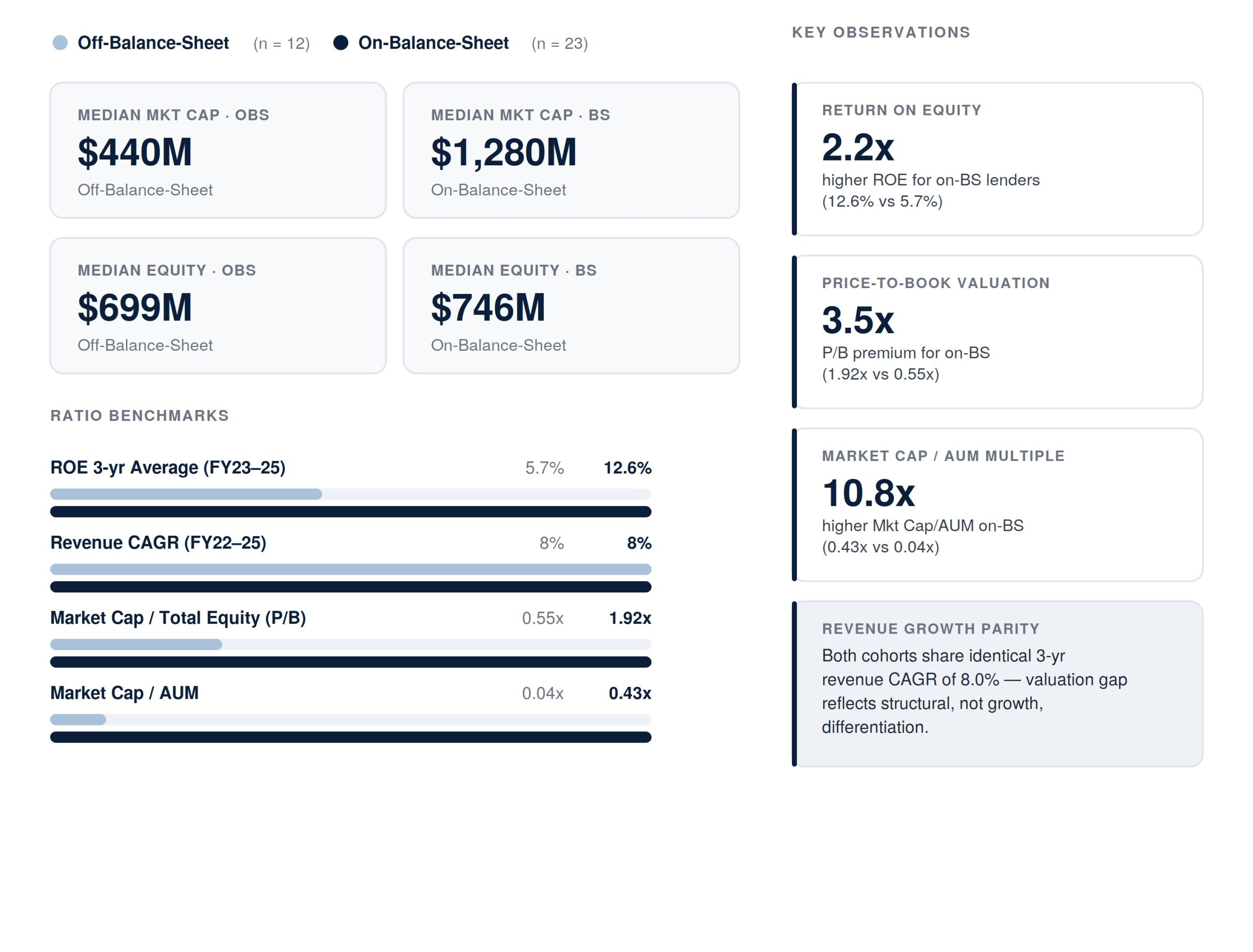
The same pattern appears in their valuations.
The history of fintech lending is, in many ways, a history of capital availability.
The first generation of marketplace lenders emerged after the Global Financial Crisis, when both lending capital and venture capital were scarce. Companies such as LendingClub, Funding Circle and Prosper had little choice but to originate loans and sell them quickly to banks and institutional investors. Holding substantial portfolios on their own balance sheets simply was not feasible.
The off-balance-sheet model solved that funding constraint and helped fintech lending scale.
As the industry matured, however, the environment changed. Warehouse facilities became more widely available, asset-backed financing markets deepened and private credit funds emerged as dedicated financing partners. At the same time, venture investors became increasingly comfortable backing lending businesses, with billions of dollars flowing into the sector between 2015 and 2022.
The pendulum shifted towards balance-sheet lending.
Companies such as SoFi, Affirm and LendingClub increasingly retained assets themselves. Once lenders could demonstrate attractive and consistent risk-adjusted returns, selling all of those assets to third parties no longer made economic sense.
Then, following the venture market correction in 2022, the pendulum began to swing back. Investors again prioritised capital efficiency and became more sceptical of businesses requiring substantial balance sheets.
The familiar assumption returned: capital-light businesses create more value.
Our analysis suggests that, in lending, this assumption misses something important.
A common misconception is that fintech lenders fail because they cannot raise enough capital. More often, the causality runs in the opposite direction: funding becomes difficult when the underlying lending performance is poor.
Institutional investors actively compete to finance lenders that consistently originate attractive, risk-adjusted assets. Warehouse providers, private credit funds and securitisation investors all want exposure to portfolios that perform well.
The genuinely scarce resource is therefore not funding. It is the ability to originate high-quality assets, repeatedly and at scale.
That distinction changes how we should think about value creation in lending.
Technology creates value by improving customer acquisition, underwriting, servicing and collections. Those capabilities allow a lender to originate better assets and generate excess economics.
The capital structure determines who captures those economics.
An off-balance-sheet lender transfers a significant portion of the future value of its assets to institutional investors. An on-balance-sheet lender retains more of it.
Viewed through this lens, the public market data become much easier to understand.
The clearest difference in our sample is profitability.
On-balance-sheet lenders generated a median return on equity of 12.6% between FY2023 and FY2025, versus 5.7% for off-balance-sheet lenders. That means balance-sheet lenders generated more than twice the shareholder return of their distribution-oriented peers.
At first glance, this may seem counterintuitive. Capital-light businesses should theoretically generate superior returns because they require less capital.
But that overlooks the underlying economics of lending.
Funding is only one cost. Customer acquisition, underwriting, compliance, servicing and collections all require substantial investment regardless of whether a lender ultimately keeps or sells the loan.
If the lender sells an asset shortly after origination, it gives up much of the future income generated by that asset while retaining most of the cost required to acquire and underwrite the customer.
That trade-off would make more sense if it enabled significantly faster growth. But our data do not show that.
Median three-year revenue growth was 8.0% for both groups.
So if off-balance-sheet lenders are surrendering more of their economics without growing faster, it follows that shareholder value may suffer.
Public-market valuations reflect that difference. Median market capitalisation to equity was 1.92x for on-balance-sheet lenders, compared with 0.55x for off-balance-sheet peers. Market capitalisation relative to assets under management was 0.43x versus 0.04x.
Despite having broadly similar median equity bases, on-balance-sheet lenders in our sample were worth almost three times as much. They traded at nearly four times the price-to-book multiple and almost ten times the market-cap-to-assets multiple.
Public markets therefore appear to recognise something that parts of the venture market still overlook:
The real value lies not simply in originating superior assets, but in retaining enough of their economics.
None of this means lenders should keep every loan they originate. Maximising the size of the balance sheet would be just as inefficient as avoiding it altogether.
The objective is not to maximise the balance sheet. It is to maximise enterprise value.
That makes capital structure an optimisation problem rather than a binary choice between on- and off-balance-sheet lending.
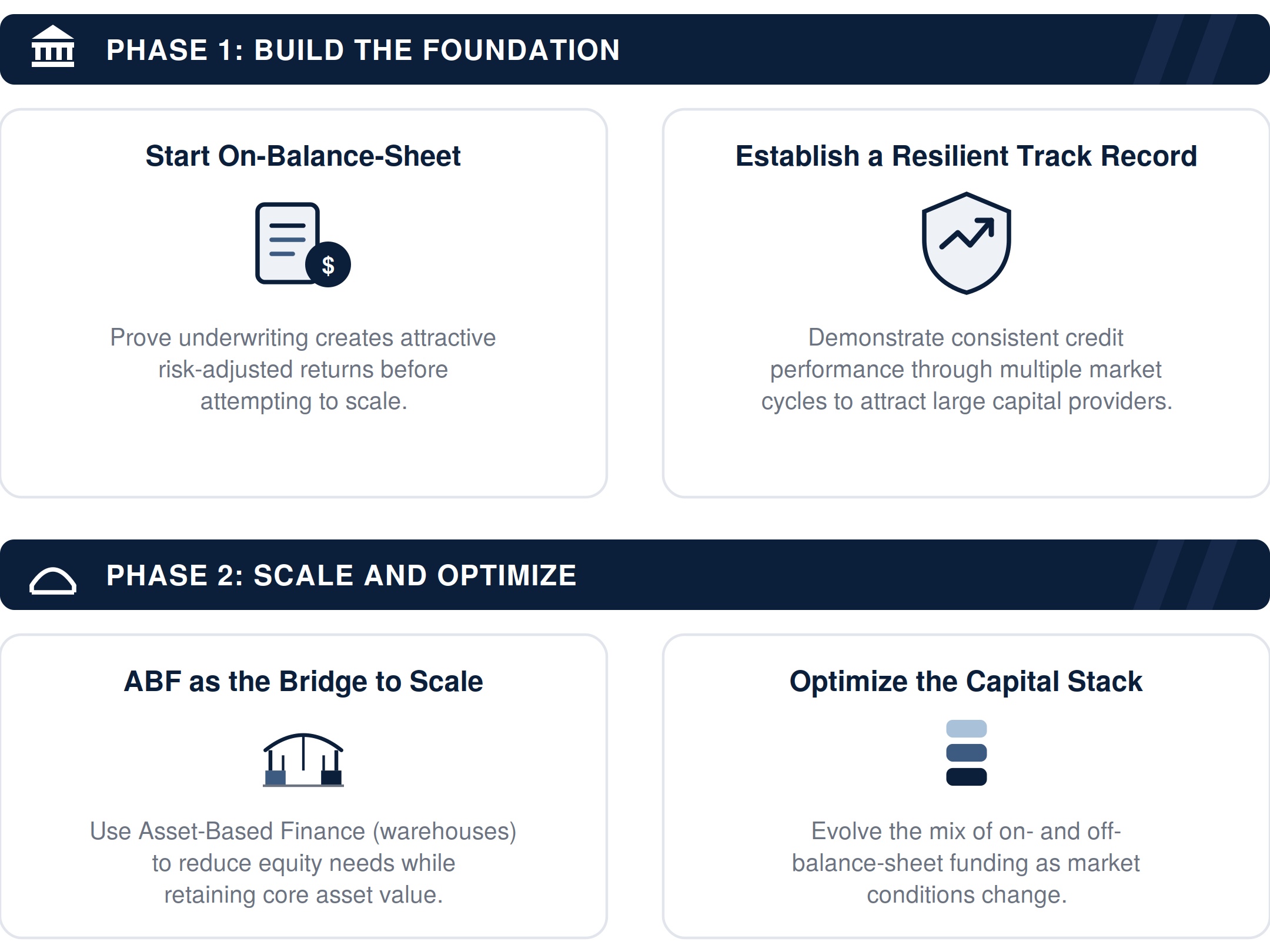
For younger fintech lenders, the starting point should be proving the lending model. They need to demonstrate that their underwriting can consistently generate attractive risk-adjusted returns, establish a meaningful performance history and show resilient credit performance as they scale.
Once that foundation exists, the capital stack can evolve.
Asset-Based Finance becomes the bridge between value creation and capital efficiency. Warehouse facilities and other forms of leverage can reduce the amount of expensive equity required to support growth without forcing the lender to surrender the majority of the economics it has worked to create.
Off-balance-sheet funding therefore has an important role — but it should complement the balance sheet rather than replace it.
The optimal mix will evolve as funding costs, portfolio performance and market conditions change. The strongest lenders will not define themselves as purely on-balance-sheet or off-balance-sheet businesses. They will build strong lending franchises first and optimise their capital structures second.
That sequence matters.
A great lending business attracts capital. Capital does not create a great lending business.
Asset-Based Finance allows venture-backed lenders to bridge the gap between the economics of a capital-intensive business and the high cost of venture equity. It gives them the leverage required to scale while allowing them to retain the assets and economics that create the most value.
That is more than a funding strategy. It is a strategy for maximising shareholder value.
If you’re considering growth debt or would like to explore how it can help accelerate your company’s growth, please connect with our team.
Deaflow: dealflow@violacredit.com
For Companies: dealflow@violacredit.com
For Prospective Investors: IR@violacredit.com
For Marketing & Media marketing@violacredit.com

1st Floor, 18 Conduit
Street, London W1S 2XN,
United Kingdom

Landmark TLV Tower A,
Leonardo da Vinci Street, Tel Aviv
6473309 Israel

126 E 56th St,
New York, NY 10022,
United States