

The Case for Fintech in the AI Age
July 2026

July 2026
You don't need another article about how AI has collapsed the cost of building software. That story has been told ad nauseum. What's interesting is what happens when you process the aftermath through an actual framework for company defensibility.
One framework, currently being used as a SaaS post-mortem, is Gokul Rajaram's eight moats of enduring companies: data, workflow, regulatory, distribution, ecosystem, network, physical and scale. His scorecard is brutally simple: a point for each moat you genuinely hold; four or more and you're durable.
The scorecard is usually applied statically, but AI is repricing these moats, not just testing them. Some are draining. Some are deepening. And once you mark the portfolio to market, a case naturally develops that fintech (specifically, fintech in the flow of funds) may be underappreciated in the AI age.
Figure 1: Gokul Rajaram’s Eight Moats of Enduring Companies
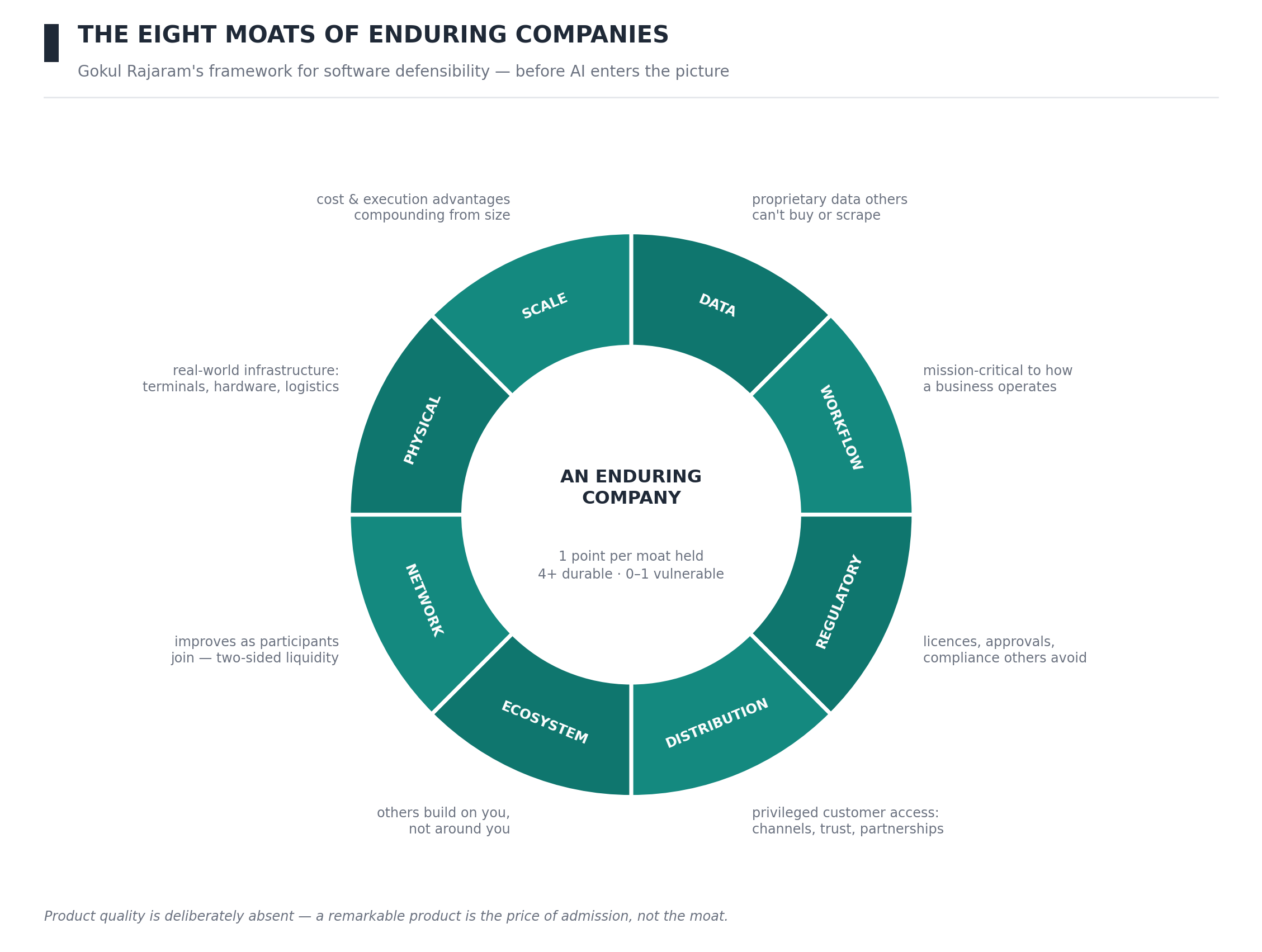
Sort the eight moats by what AI does to them and a pattern emerges.
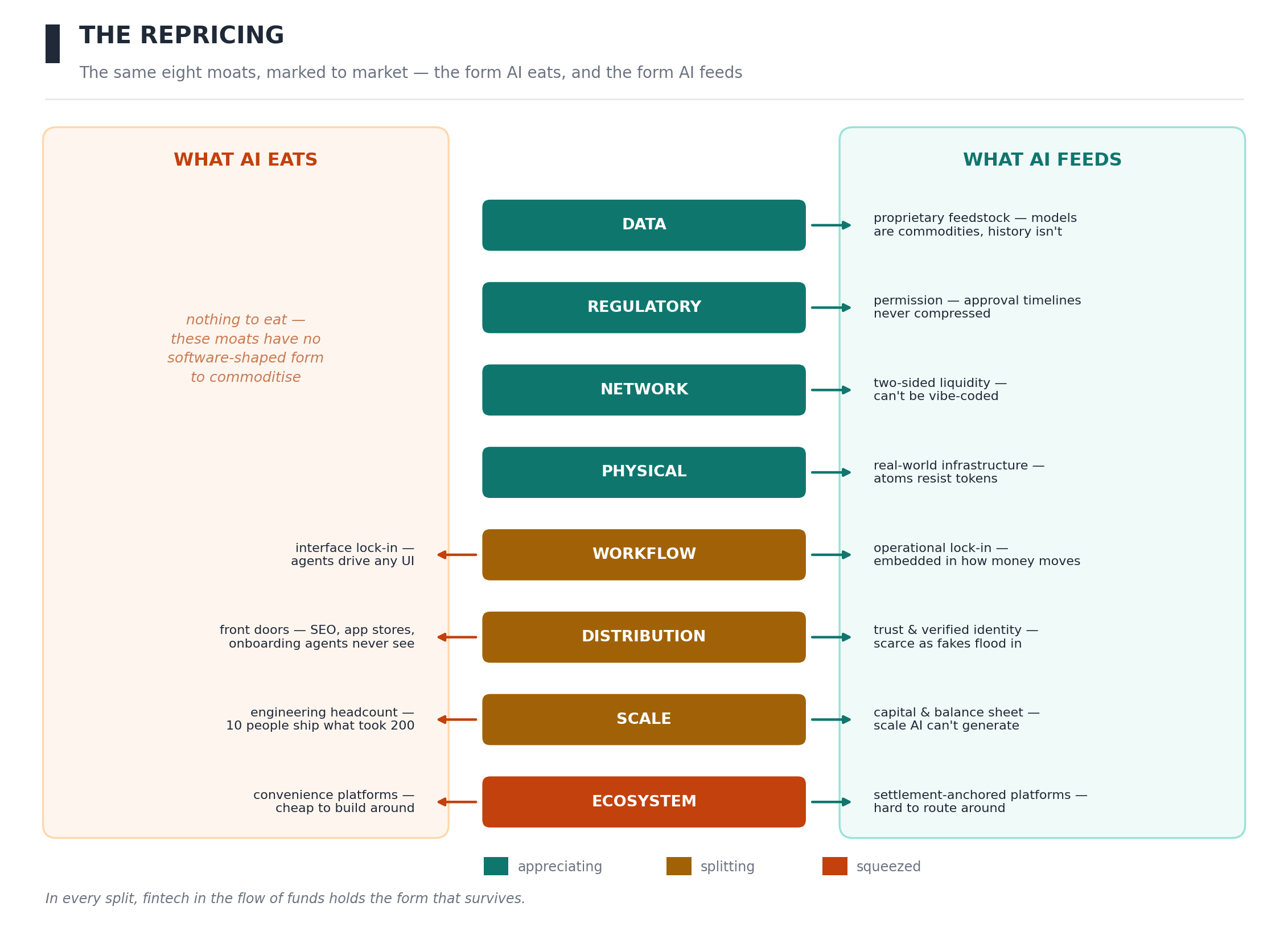
Four are appreciating. Data gets more valuable because the layer above it commoditised: everyone can rent the same frontier model; almost no one has a decade of proprietary history to point it at. Regulatory moats deepen on pure asymmetry: AI compressed build timelines from years to weeks and compressed approval timelines by approximately nothing. When the cost of building collapses while the cost of permission doesn't, permission becomes the bottleneck. Network effects strengthen because a coding model can replicate your software but cannot make both sides of a market show up; liquidity cannot be vibe-coded. Physical infrastructure does what it has always done: sits there, expensively, being impossible to clone over a weekend.
One is squeezed. Ecosystem moats cut both ways under AI: it lowers the cost of building on your platform, as well as the cost of building around it. The moat holds where it’s anchored to something hard, like settlement or regulatory cover, and drains where it’s anchored to convenience.
And three don't deflate so much as split. Workflow, distribution and scale each divide into a form AI eats and a form AI feeds. Workflow built on a familiar arrangement of screens is in trouble, because agents can drive any interface; workflow embedded in operations deepens. Distribution built on front doors an agent will never see (app store rankings, SEO, a beloved onboarding) will be distrupted; distribution built on trust appreciates. Scale built on engineering headcount evaporates; scale in inputs AI can't generate survives.
And one pseudo-moat doesn't survive the sorting at all: product quality as a proxy for scale. A remarkable product was always the price of admission, not the moat. AI just made that explicit. Those three splits, and the appreciating column above them, are where the case for fintech assembles itself. In each case, fintech in the flow of funds emerges structurally well-positioned.
Figure 2: A View of the Repricing of the Eight Moats
Money movement is the deepest operational dependency there is. It is the surviving form of the workflow moat in its purest state. When your product runs payroll, settles invoices, holds customer balances, or provides liquidity, churn isn't a migration; it's open-heart surgery. No CFO rips out the payments stack for marginally cleverer software, and no agent rerouting the interface changes what the plumbing underneath is doing.
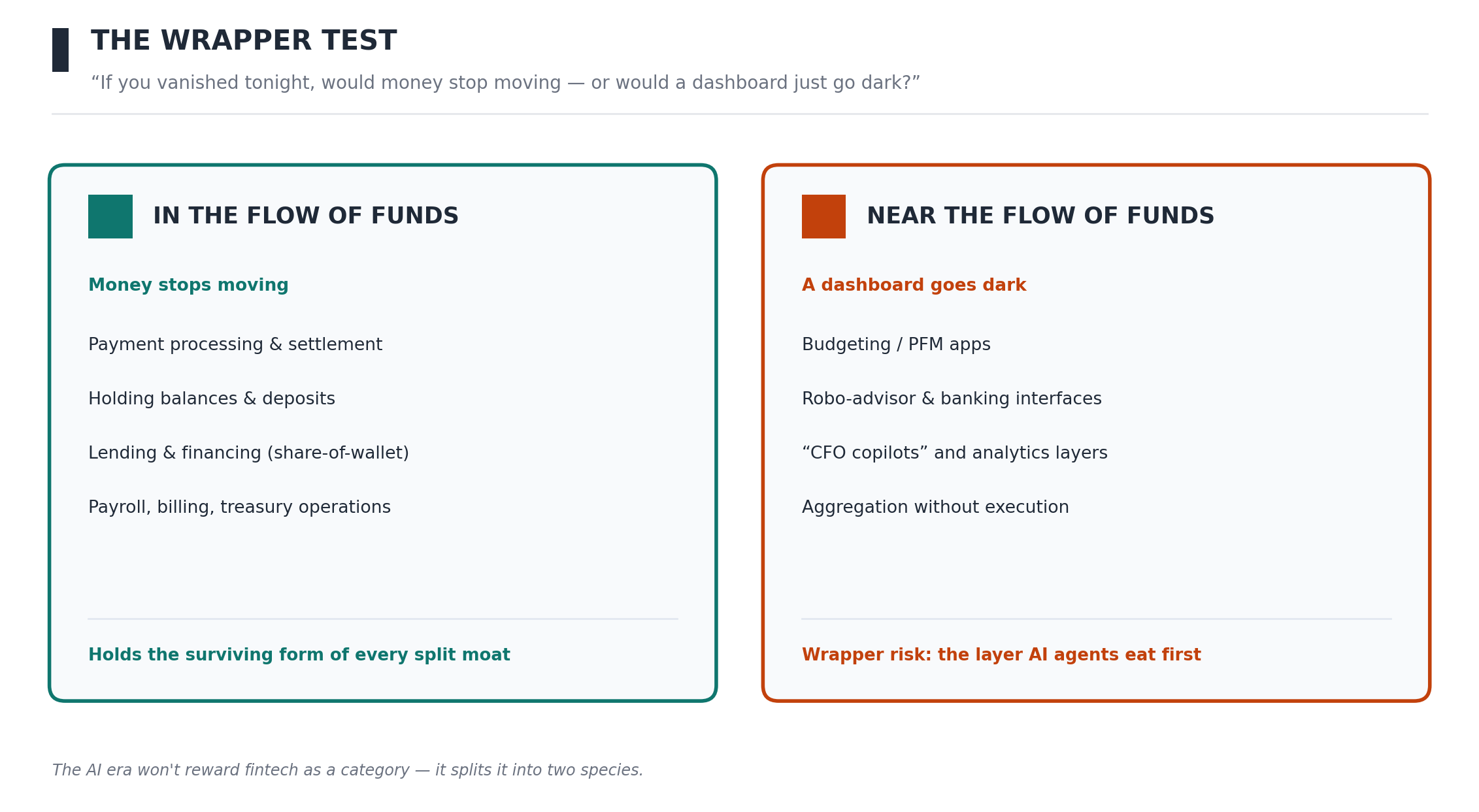
The distinction does real work, and it cuts within fintech, not just around it. A budgeting app, a robo-advisor skin, a CFO copilot (on their own), is exactly the thin wrapper AI eats first. The dividing line is a one-question test: if you vanished tonight, would money stop moving, or would a dashboard just go dark? It's the companies that pass that test that are driving the industry's quiet shift toward embedded, B2B money movement and financing.
Figure 3: The Wrapper Test
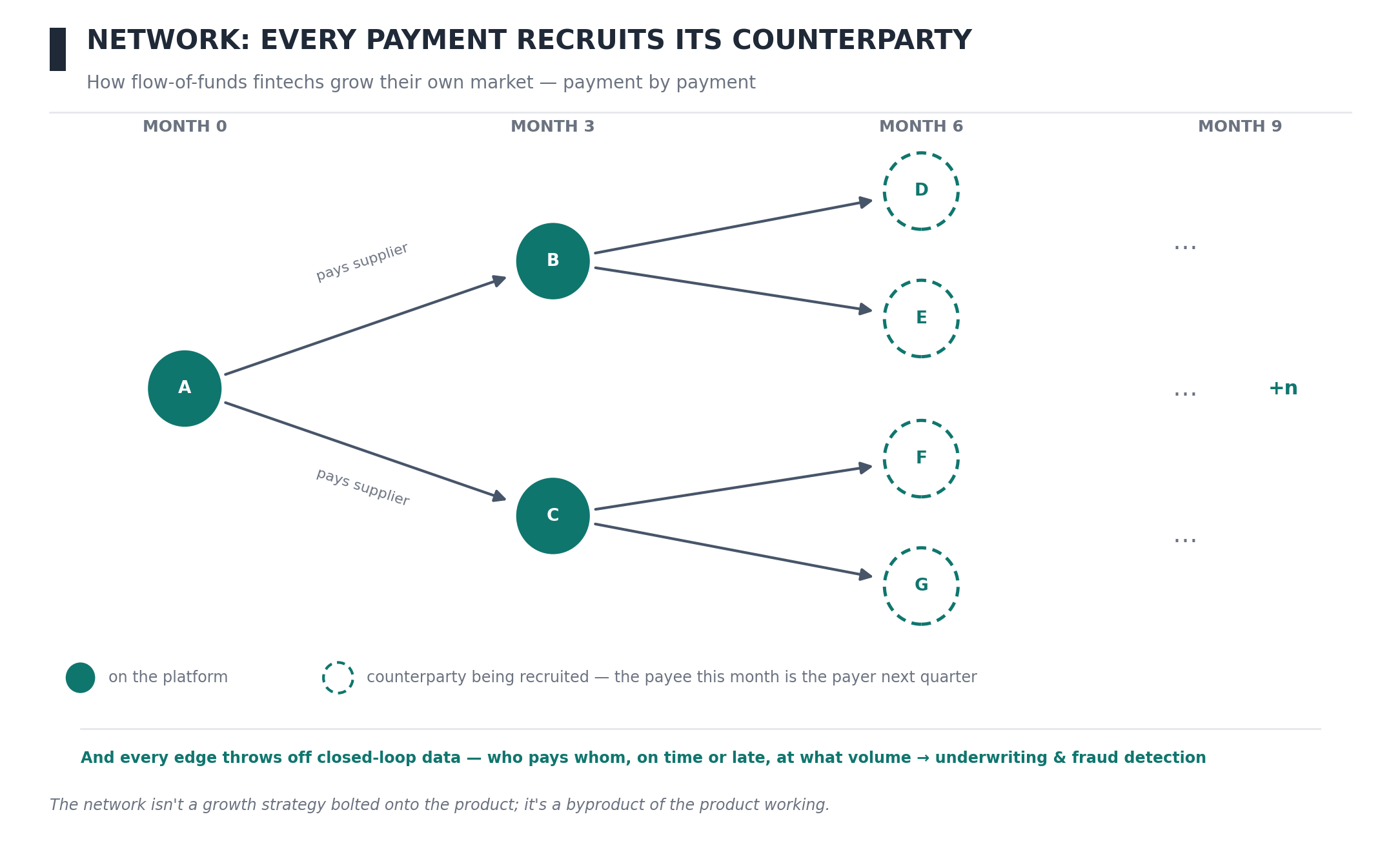
Every transaction has two sides, and that one fact hands flow-of-funds fintechs a network moat most software companies spend a decade trying to manufacture. A B2B payments platform onboards a new node with every invoice it settles: the supplier paid through it this month is the customer paying through it next quarter. A BNPL provider compounds in both directions at once; each merchant added makes the product more useful to shoppers, each shopper more valuable to merchants.
This is the moat AI cannot vibe-code. A model can replicate the software over a weekend; it cannot make the counterparties show up, and it cannot replicate the closed-loop data the network throws off (who pays whom, on time or late, at what volumes), which feeds straight back into underwriting. The network isn't a growth strategy bolted onto the product; it's a byproduct of the product working. Every payment is an acquisition event.
Figure 4: Payment Network Effects
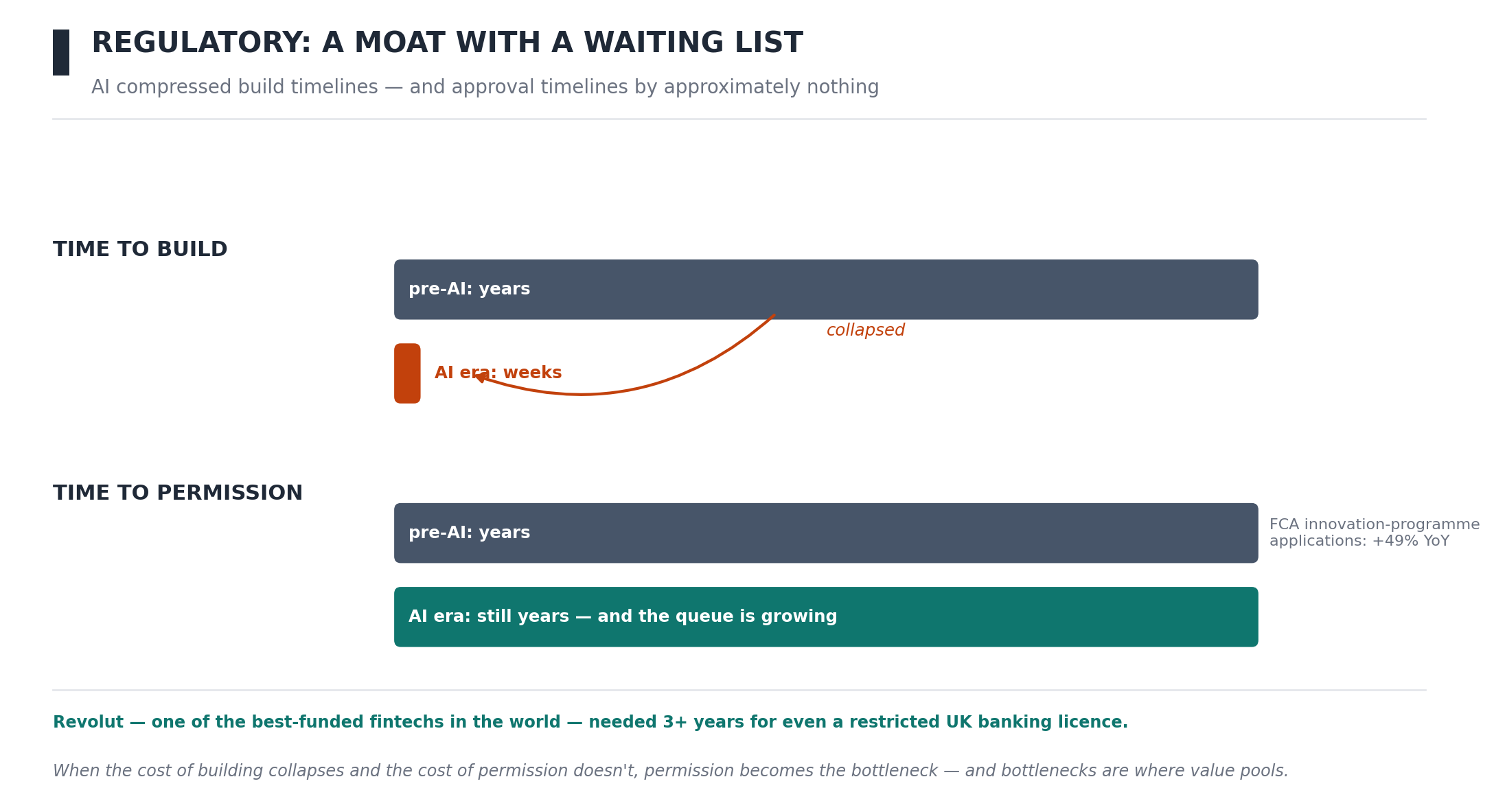
For most software, regulatory advantage is extra credit. In finance it's constitutive: you legally cannot vibe-code a deposit-taker. And the asymmetry does all the work: AI compressed build timelines from years to weeks, and approval timelines by approximately nothing. The licences, authorisations and compliance functions that made fintechs look slow next to pure SaaS have just been revalued as sunk, uncloneable assets. Permission became the bottleneck, and bottlenecks are where value pools.
Revolut, one of the best-funded fintechs in the world, needed more than three years to secure even a restricted UK banking licence; an AI-native challenger starting today joins the back of a lengthening queue, with applications to the FCA's innovation programmes running 49% above last year. The moat's honest limit is that it protects the plumbing, not the relationship — unregulated AI can give the guidance, but the moment advice becomes action, liability snaps back onto a regulated balance sheet. Which is the next moat.
Figure 5: Payment Network Effects
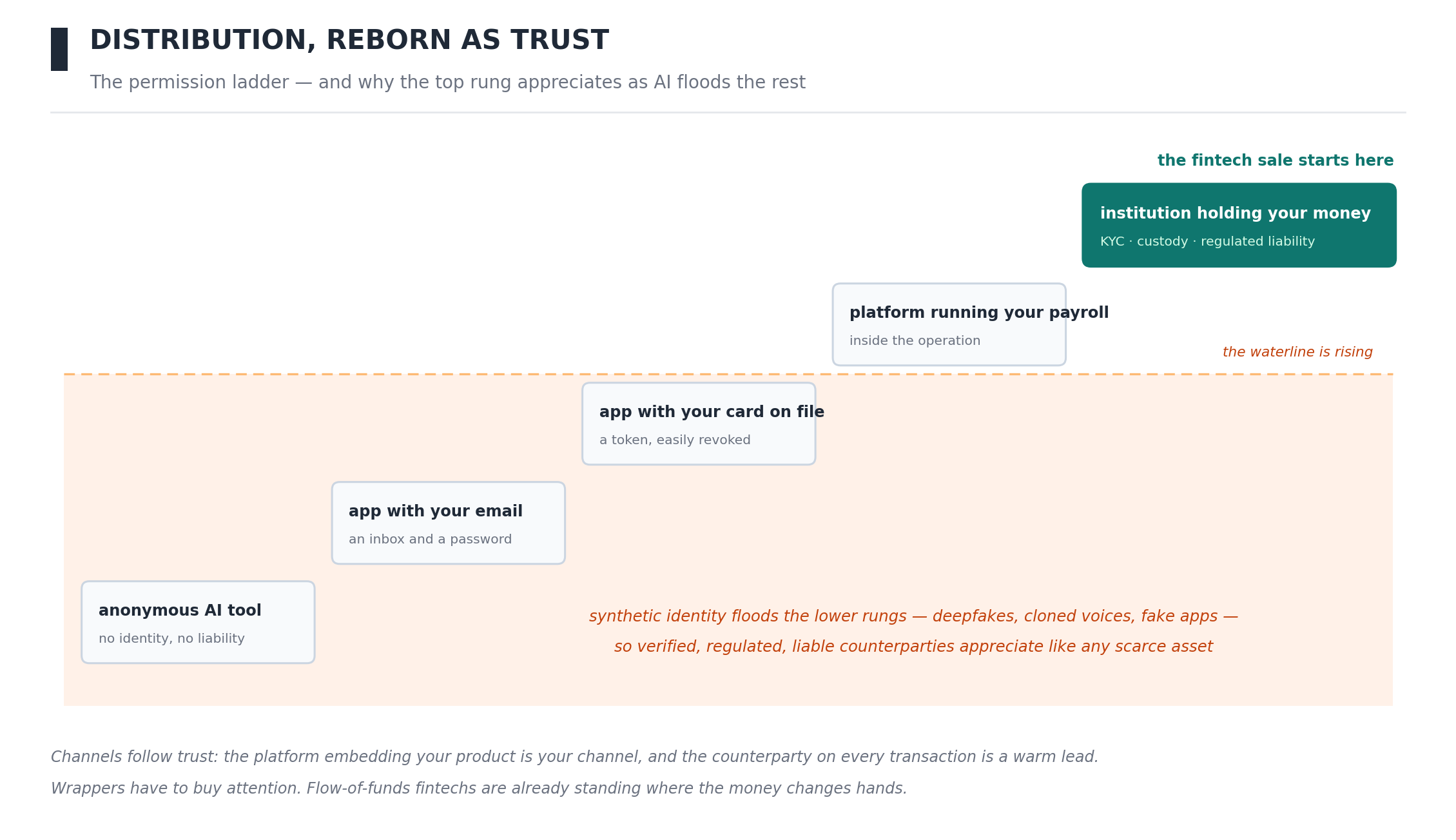
Distribution was never only front doors. In Rajaram's framing it also comes from trust, channels and partnerships. AI is destroying the front-door form and revaluing the other two, and flow-of-funds fintechs hold structural advantages in both.
Start with trust. A fintech clears the highest trust bar in commerce on day one: customers gave it their money. Passing KYC, custodying balances, running payroll: the sale itself creates a depth of permission no productivity app ever acquires, and that asset appreciates fast in a world where generative AI makes everything else cheap to fake. As synthetic identity floods every channel, the verified, regulated, liable institution becomes the scarce counterparty; and the fintech already holding the customer's money or lending to its clients is already that institution.
Then channels. Sitting in the flow of funds makes partnership distribution almost ambient. The platform that embeds your financing is also your channel; the counterparty on every transaction is a warm lead; the vertical-software OS that runs a merchant's business will distribute the accounts, payments and lending of whoever sits in its flow, which is why embedded finance is less a product category than a distribution strategy. Wrappers have to buy attention. Flow-of-funds fintechs are already standing where the money changes hands.
Figure 6: The Trust Ladder
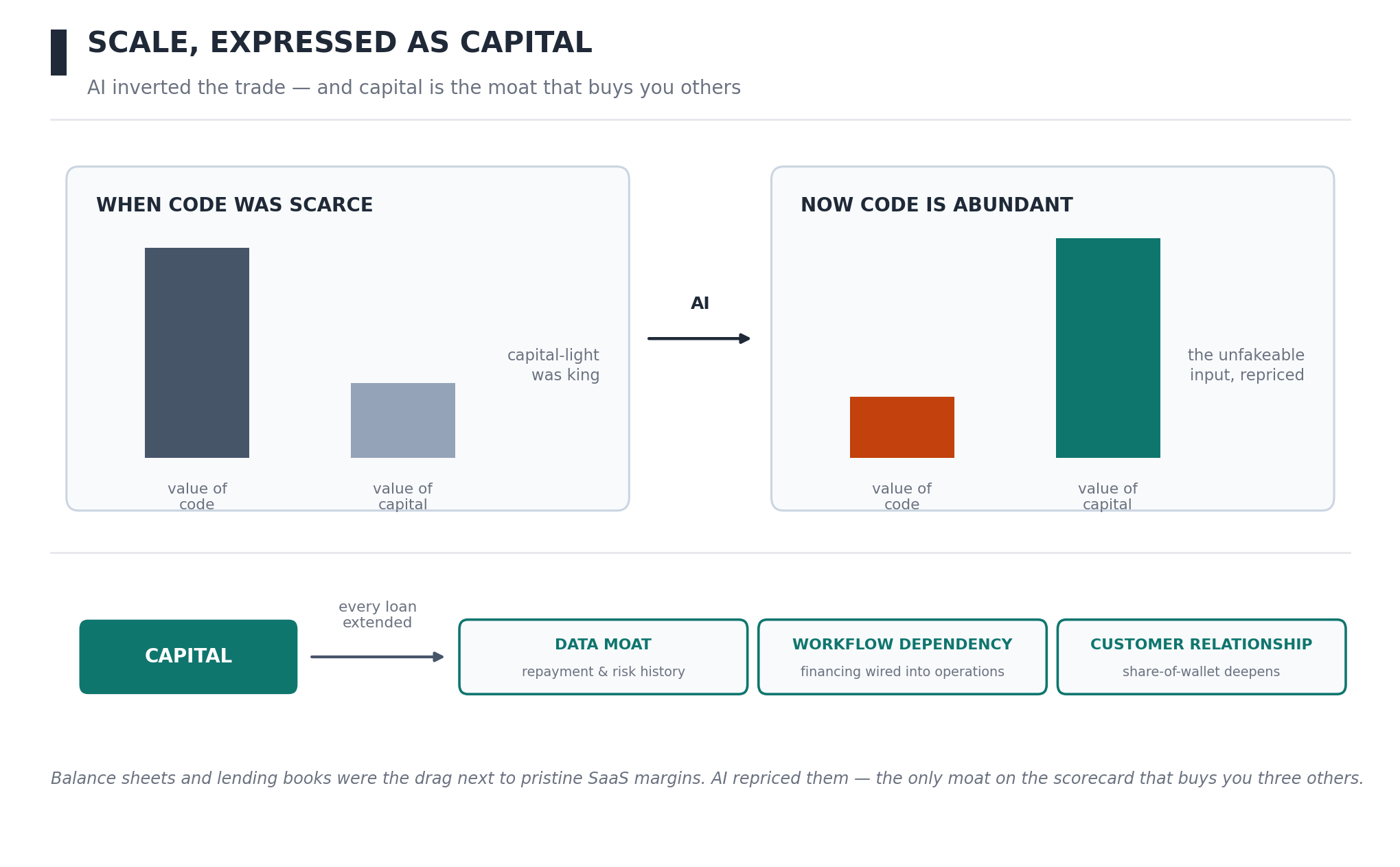
Finally, the moat nobody wanted. The headcount form of scale is the era's biggest casualty: but fintech can hold scale in a different input: capital. Balance sheets, lending books, share-of-wallet earned through financing were, for a decade, the things investors penalised fintech for: the capital-intensive drag next to pristine SaaS margins. AI inverted the trade. When code was scarce, capital-light was king; now code is abundant, and the unfakeable inputs like capital, licences, liquidity, may be repriced upward. Better still, capital is the moat that buys you others: every loan extended deepens the data moat, the workflow dependency and the customer relationship simultaneously.
Figure 7: The Trust Ladder
Score it honestly and a flow-of-funds fintech holds the surviving form of all these moats: workflow as operations, distribution as trust, scale as capital, plus network and regulatory. That's five, before counting data. Rajaram's threshold for durability is four. Most pure software businesses, scored with the same honesty, would struggle to reach three.
None of this makes fintech the winner of the AI era, nor is it a claim that fintech returns will outperform. The claim is narrower. AI repriced technology moats away from code, interfaces and headcount, toward permission, liquidity, data and capital. Fintech, through the accident of its own constraints, happens to be long the appreciating side of that trade.
If you’re considering growth debt or would like to explore how it can help accelerate your company’s growth, please connect with our team.
Deaflow: dealflow@violacredit.com
For Companies: dealflow@violacredit.com
For Prospective Investors: IR@violacredit.com
For Marketing & Media marketing@violacredit.com

1st Floor, 18 Conduit
Street, London W1S 2XN,
United Kingdom

Landmark TLV Tower A,
Leonardo da Vinci Street, Tel Aviv
6473309 Israel

126 E 56th St,
New York, NY 10022,
United States